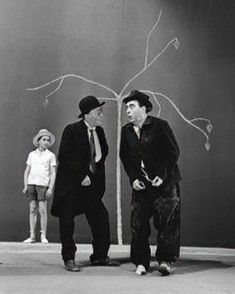
‘We experimented all night long with that plaster tree, making it bigger, making it smaller, making its branches finer. It never seemed right to us. And each of us said to the other, maybe‘
Alberto Giacometti.
In the process of putting this site together I came across some photos of an old piece that never really worked out for me. I was trying to make a tree out of some fallen wood from the park held together with plasticene and string. I couldn’t get it to stand up. It was thin and grey and wonky.
Seeing the photo again made me think about the tree in Samuel Beckett’s ‘Waiting for Godot’.
Apart from perhaps ‘a road’, ‘a mound’ and ‘the moon’, the tree is the only defined, physical piece of set within the play. It is a solitary visual anchor in an otherwise nondescript stage set.
It marks where the play takes place. A place for the ‘action’. It has its own character, significance and presence.
Vladimir and Estragon refer to the tree throughout the play. They consider it and talk about it. It reminds them of the reason they are there (if their memory serves them correctly).
It is where Vladimir and Estragon have been told to wait for Godot, although they are not even sure it is the right tree or the same tree as the day before. The play opens and closes with them at it. They do not leave it. It appears dead in Act 1 but has some leaves in Act 2.
They consider hanging themselves from it (twice), they try to hide behind it (too thin) and they also emulate it by trying to do ‘the tree’ from yoga. It is also a stopping point and a passing place for the other characters in the play (Pozzo, Lucky and the Boy).
The tree has become symbolic or representative of the play and has been copied, reproduced, made anew and given different treatments depending on the production and context.
There is also a fair amount of academic and scholarly writing about the tree; its meaning, symbolism and relationship to other aspects of Beckett’s writing, staging and the wider use of objects/props within his work.
The tree’s own story is an interesting one.
When the play was first performed at the Théâtre de Babylone in Paris 1953 it is said that the tree was a fairly impromptu affair made by the director Roger Blin out of wire coat hangers and tissue paper with a foam rubber base.
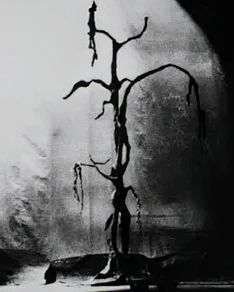
Photographs from the time show the tree as a dark, slightly ominous, plantlike and bedraggled form that looks like it has emerged from the bog.
Vladimir and Estragon discuss the appearance of the tree in differing ways:
VLADIMIR:
He said by the tree. (They look at the tree.) Do you see any others?
ESTRAGON:
What is it?
VLADIMIR:
I don’t know. A willow.
ESTRAGON:
Where are the leaves?
VLADIMIR:
It must be dead.
ESTRAGON:
No more weeping.
VLADIMIR:
Or perhaps it’s not the season.
ESTRAGON:
Looks to me more like a bush.
VLADIMIR:
A shrub.
ESTRAGON:
A bush.
Apparently Beckett was not happy with the first incarnation of the tree and it was consigned to storage. From there it’s whereabouts became unknown.
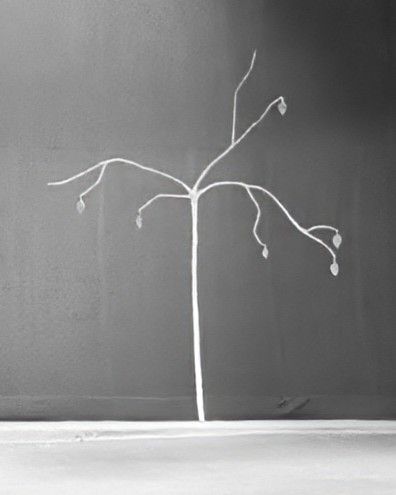
Beckett’s friend Giacometti was in the audience of the first performance and later accepted Beckett’s invitation to make a new tree for a revival production of Godot at the Paris Odeon in 1961. Giacometti and Beckett worked on it together, adding and removing to reach the dry, haunted, birch-like ghost tree that it appears to be from photographs. Like Giacometti’s figures it is thin, drawn and spindly.
After the production the tree went into storage again where it was reportedly destroyed when students occupied the building in May 1968.
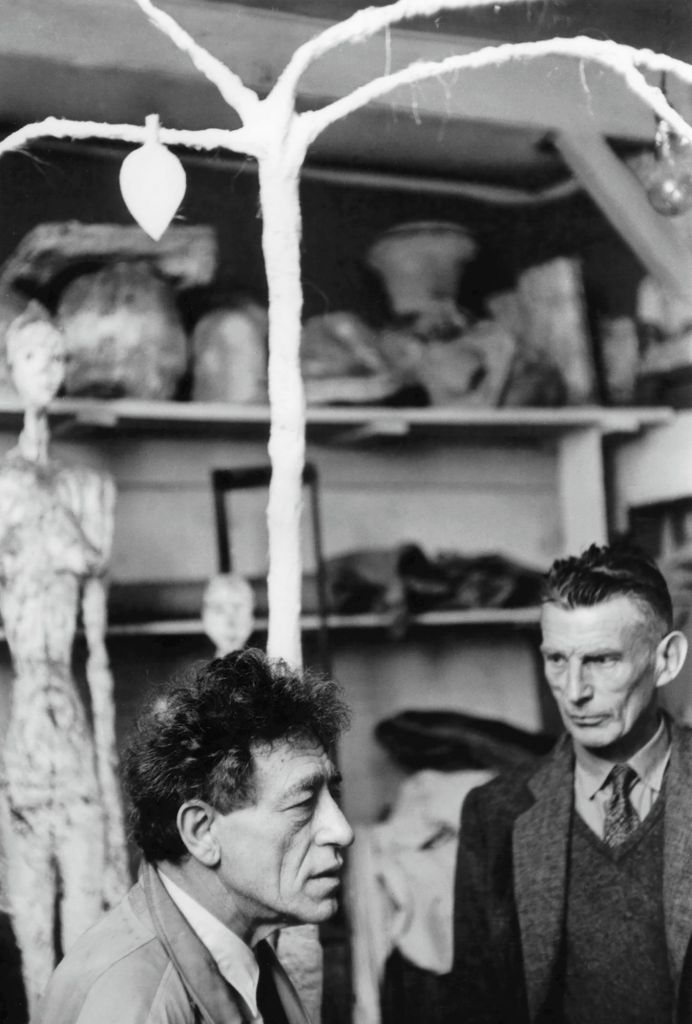
Both the willow and the birch are accurate of the flora of Beckett’s homeland. They are both ancient and native to the British Isles prior to their separation from Europe. The tree could also therefore be seen as a marker of time and existence and continuation in contrast to the inertia, ennui and existential futility of the players.
It offers the possibility of escape and hope.
 Dominic Persad
Leave a comment